Preface
Welcome to ProFacet!
ProFacet works a bit differently than other gem design tools. Under the hood, every design is defined by a text-based "recipe" written in FSL (Facet Specification Language), Lua, or — for the mathematically adventurous — APL.
You don't have to write this code yourself. As you work with the visual tools like the Interactive Slicer, ProFacet writes the code for you automatically. You can create entire designs just by clicking and dragging.
However, this recipe is always there, visible and editable. This means you get the best of both worlds: the ease of a visual interface and the precision of a text definition. You can switch between them at any time — like having cruise control and a manual gearbox. While you can operate the tool entirely through the UI, most users find they naturally start using both: the UI for the heavy lifting and the code for quick tweaks or precise adjustments. FSL is ideal for quick, declarative tier definitions, Lua offers the full power of a general-purpose programming language, and APL provides a concise mathematical notation for those who think in arrays and linear algebra.
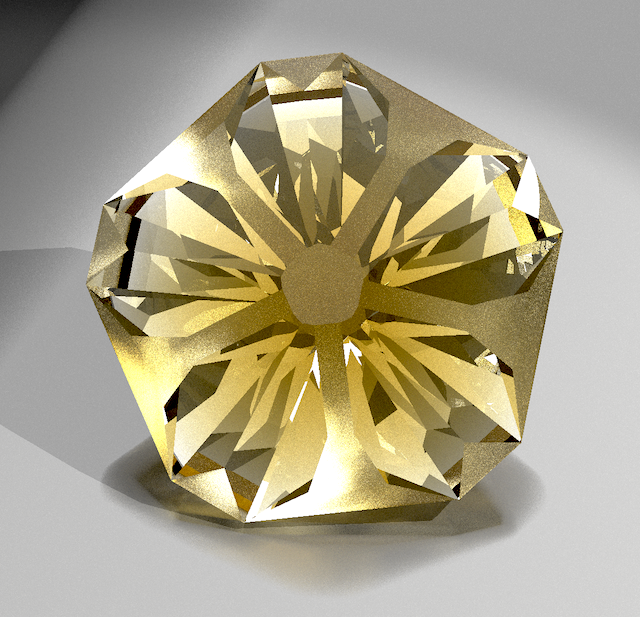
This image is made in ProFacet using the upcoming path tracer. Explore more designs in our Gallery.
Design Goals
The project is guided by the following principles:
Scientific Rigor. Optical performance analysis in ProFacet is held to the standard of a scientific instrument.
Realistic Results. Most existing tools produce renderings where the contrast looks noticeably different from what a real stone looks like. The primary culprit is unrealistic lighting, in particular the widespread use of head shadow, a lighting convention so far removed from how light actually behaves in the real world that it is almost comical. That said, head shadow is not without merit: by blocking the direct return path, it forces the design to prove it can gather and redirect light from oblique angles, which is a genuinely useful diagnostic. ProFacet respects this duality. It offers rigorous analytical lighting and a physically-based path tracer.
Engineering Excellence. ProFacet is built as a professional-grade engineering product.
A Cutting-Edge Optimizer. The built-in optimizer is not an afterthought. It is a first-class subsystem that can explore a vast design space, tune every parameter simultaneously, and converge on solutions that a human would be unlikely to find by hand. It is the engine that turns a good design into a great one.
Blazing Speed. Performance is a core requirement, not a nice-to-have. Life is too short to wait for a progress bar.
Parametric Design. Every ProFacet design is defined by a parametric recipe written in FSL, Lua, or APL. This means a single design file can express an entire family of stones: vary the angles, adjust the proportions, change the symmetry, all from one specification. This unlocks workflows that point-and-click tools simply cannot offer.
Beauty. A tool for designing beautiful objects should itself be beautiful. From the rendered stone previews to the documentation you are reading right now, ProFacet aims to be a joy to look at and a pleasure to use, but we are not there yet ;)
Documentation Structure
Because the coding part is optional, we've organized the documentation into three parts:
- Part 1: The Studio covers the visual tools you need to design and cut. This is all you need to get the job done.
- Part 2: FSL Reference covers FSL, the purpose-built Facet Specification Language. It serves as an alternative to the UI for quick, declarative design tier adjustments.
- Part 3: Lua & APL Reference covers Lua, the general-purpose programming language, and APL, a mathematical notation for array-oriented gemstone design. Lua is designed for advanced geometric constructions and scripting. APL (experimental) is for mathematicians who want to express gemstone geometry as pure linear algebra.
If you're interested in learning how to read or write the recipes directly, check out Part 2 and Part 3. Otherwise, feel free to stick to Part 1 and just cut!
Contact
If you have questions, feedback, or need support, join our Discord community.